 UniWest
 Industrial finishing is the process of improving a part’s surface after it has been cut, cast, machined, blasted, welded, or fabricated. Depending on the part and its next use, that may mean removing burrs, cleaning residue, smoothing edges, polishing, creating a better appearance, or preparing the surface for coating. The right approach helps parts look cleaner, feel safer to handle, and move into the next stage with fewer issues.
Finishing is not always one single step. In many shops, it is a combination of tools, abrasives, compounds, and media that work together.
What Industrial Finishing Does
At its core, industrial finishing is about making a surface more usable. A freshly cut or fabricated part may have sharp edges, tool marks, surface contamination, light corrosion, or an uneven texture. Those conditions can affect appearance, coating adhesion, assembly, and even worker handling.
Finishing helps address common needs like:
- Removing burrs or sharp edges
- Cleaning oils, residue, scale, or corrosion
- Smoothing rough surfaces
- Creating a more uniform appearance
- Preparing parts for paint, coating, or assembly
- Polishing or burnishing metal components
The right method depends on the part material, the finish requirement, and whether the work is being done one part at a time or in larger batches.
Tools and Supplies That Support the Process
Different finishing jobs call for different products. A small batch of delicate parts may need a much different approach than a large production run of metal components.
UniWest lists several product categories that support industrial finishing, including: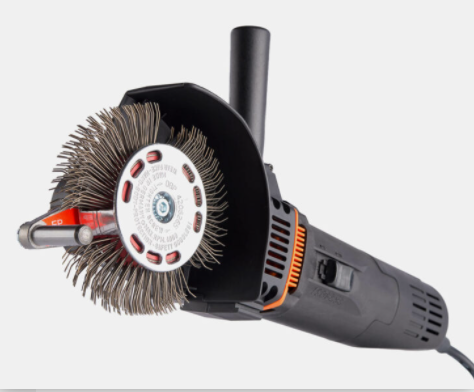
- Bristle Blaster
The Monti Bristle Blaster® is designed for corrosion, mill scale, and old coating removal. The tool can create surface cleanliness similar to grit blasting and generate an anchor profile, including in areas where blasting may not be permitted. - Vibratory Tumbling Compounds
Our compounds include general-purpose cleaner, heavy-duty cleaner, burnishing compound, rust inhibitor, and dry burnishing compound. These support cleaning, polishing, rust control, and residue management in tumbling applications. - PSA Discs and Sanding Belts
We offer PSA discs and sanding belts for surface prep and sanding needs. Their PSA discs are listed in 5-inch and 6-inch sticky-back options, while belts are available in a range of sizes and grits from 36 to 600 for anything from stock removal to fine finishing. - Tumbling Media
Our tumbling media category includes ceramic, millimeter size media, plastic, and synthetic options. These media choices help shops match the finishing process to the material, part shape, and desired result.
Why Media and Compounds Matter
In industrial finishing, the media or compound often determines the result. Tumbling media provides the contact that deburrs,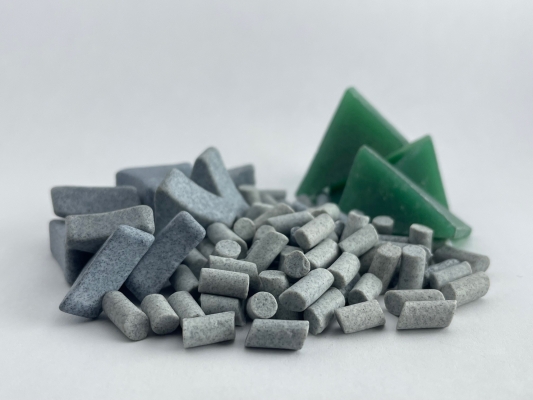 smooths, or polishes. Compounds help control cleaning, residue, burnishing, and rust inhibition. Sanding belts and discs provide a more direct surface-removal method when a part needs shaping, edge work, or a specific surface refinement.
For example, our general-purpose vibratory compound is described as helping control the white film residue that can occur with plastic and synthetic finishing and deburring media, while the heavy-duty cleaner is intended for heavier oils and grease and includes inhibitors to help control rust on ferrous metals.
That level of fit matters. Choosing the wrong product can create extra cleanup, inconsistent finishes, or unnecessary wear on parts and media. Choosing the right product helps the process become more predictable.
How to Choose the Right Industrial Finishing Approach
Before selecting supplies for industrial finishing, start with a few practical questions:
- What material is the part made from?
- Are you removing burrs, corrosion, oil, coating, or residue?
- Does the part need a rougher surface, a smoother finish, or a polished appearance?
- Is this a one-off part, a small batch, or a repeated production job?
- Will the part be coated, assembled, stored, or shipped afterward?
These questions help narrow whether the job is better suited for sanding, bristle blasting, tumbling media, cleaning compounds, or burnishing products.
Better Results Start at the Surface
A finished part is easier to handle, cleaner to inspect, and better prepared for whatever comes next. Whether the goal is deburring, polishing, cleaning, rust inhibition, coating prep, or surface refinement, industrial finishing helps turn rough or inconsistent parts into more reliable finished components.
At UniWest, our finishing selection provides a helpful look at the types of products shops rely on to support that process, from Bristle Blaster tools and sanding products to tumbling media and compounds. When the supply choice matches the part and the goal, finishing becomes less of a guessing game and more of a repeatable part of production.